BIOLEACHING OF A SULFIDE-Cu, Zn MINERAL BY Acidithiobacillus sp., ISOLATED FROM ACID MINING DRAINAGE, LA LIBERTAD (PERU)
DOI:
https://doi.org/10.5281/zenodo.7213666Abstract
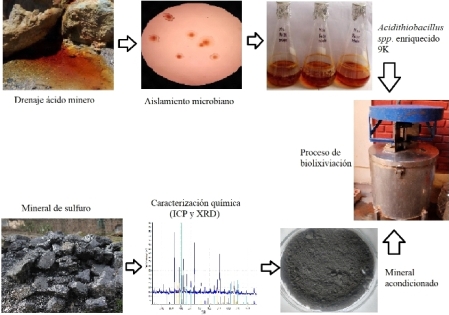
Acid mine drainage (AMD) is a potential source for the isolation of microorganisms with the ability to leach sulfur ore; for this reason, its use of these effluents allows the choice of sustainable technologies and improves the recovery of metals of commercial value. The objective of this research was to bioleach a sulfur ore by Acidithiobacillus sp., isolated from an AMD of La Libertad (Peru). AMD samples were enriched in 100 ml of 9K medium at pH 2.5 at 23 ± 2 °C for 14 days and a pure microbial culture was isolated in 9K-agarose medium. It was characterized by Gram stain and its physiology using inorganic media (elemental sulfur, ferrous ion and sodium thiosulfate), obtaining typical characteristics of Acidithiobacillus sp. Its ferrous ion oxidation rate was determined at different pHs (1.5, 2.5 and 3.5) and its bioleaching capacity of a sulfur ore, obtained from the Sayapullo district - Peru, for 25 days at 400 rpm with pH 2.5. The results showed a higher ferrous ion oxidation rate of 50.13 ± 5.4 mg/L.h at pH 2.5 and presented a higher recovery of copper (Cu), zinc (Zn) and gold (Au) with 52, 54 and 30%, respectively, with a solution iron 31%. Therefore, it is shown that Acidithiobacillus sp. obtained from AMD of La Libertad (Peru), it can be used as an alternative to recover metals of commercial value by bioleaching sulfur ore.Downloads
Download data is not yet available.
Downloads
Published
2022-10-24
How to Cite
Quiñones Cerna, C., Bejarano, R., Vega, J., Rodriguez, J., & Robles, H. (2022). BIOLEACHING OF A SULFIDE-Cu, Zn MINERAL BY Acidithiobacillus sp., ISOLATED FROM ACID MINING DRAINAGE, LA LIBERTAD (PERU). LatinAmerican Journal of Metallurgy and Materials, 42(1), 41–50. https://doi.org/10.5281/zenodo.7213666
Issue
Section
Regular Articles
License
The authors of papers accepted for publication by the RLMM, should recognize the complete transfer of copyright (in all languages) to the RLMM. This transfer includes the right by the RLMM to adapt the article for digital or printed reproduction without altering the written content and information displayed in tables or figures within. The authors retain the copyright and guarantee the journal the right to be the first publication of the work as well as licensed under a Creative Commons Attribution License 4.0 Internacional (CC BY 4.0) which allows others to share the work with an acknowledgment of the authorship of the work and the initial publication in this journal.